
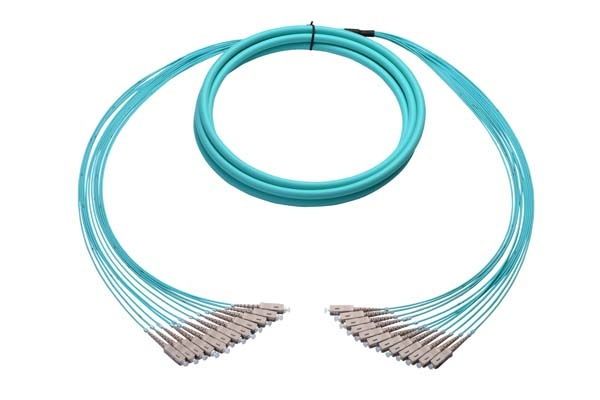
Understanding Fiber Breakout Cable Uses and Benefits
In many network setups, cables can slowly turn into a quiet problem. They sit behind racks, often unnoticed, yet they affect how well everything runs. When there are too many separate patch cables, the space feels tight and messy.
This is where a fiber breakout cable finds its place. It is not a complex idea, yet it solves a real issue. For teams working with fiber systems, it brings some order. In this blog, we will talk about its uses, its simple benefits, and how it fits into everyday network work.
What is a Fiber Breakout Cable
A fiber breakout cable is a structured cable assembly that combines multiple fiber strands into one outer jacket. Inside, each fiber is still protected, but the outer layer keeps them together as a single unit.
It is often used when several duplex patch cables would otherwise be needed. Instead of running many loose cables, one cable can handle the same job.
Key points to understand:
- It groups multiple fibers into one cable body
- Each fiber can still be used separately
- It reduces loose cable clutter
- It is built for both simple and complex networks
This design may look basic, yet it answers a common problem in network rooms where space is limited.
Overview of 12 Fiber Breakout Cables
Among the different types, the 12-fiber breakout cable is quite common. It combines twelve fibers into one assembly, which can replace six duplex cables.
This type of cable is practical for medium to large network setups where multiple connections are required in one place.
Features include:
- Support for connectors like LC, SC, and ST
- Compatibility with Single-Mode (OS2) and Multimode (OM1, OM2, OM3, OM4)
- Options for riser (OFNR) and plenum (OFNP) rated jackets
- Length choices from 2 meters to 100 meters
- Custom lengths and bulk options when needed
This structure allows teams to manage several connections without dealing with too many separate lines.
Common Uses in Network Environments
The fiber breakout cable is used in many practical situations. It is not limited to one type of network or location.
Typical use cases:
- Data centers where high-density connections are required
- Server rooms that need clean cable paths
- Office networks with structured cabling systems
- Backbone connections between network racks
In each of these spaces, the aim is simple. Reduce clutter while keeping performance steady. The cable helps make that possible without adding extra steps.
Key Benefits of Using Fiber Breakout Cable
When people shift to a fiber breakout cable, they often notice small changes first. Over time, those small changes make a larger difference.
Main benefits include:
- Reduced Cable Clutter
Fewer cables mean less confusion. It becomes easier to trace connections when needed. - Simplified Installation
Handling one cable is easier than managing several separate ones. It saves effort during setup. - Better Cable Protection The outer jacket adds an extra layer of safety against wear and minor damage.
- Space Efficiency
Rack space is limited in most setups. A compact cable layout helps keep things organized. - Improved Airflow
Less cable bulk allows better airflow inside racks, which can help maintain stable conditions.
These benefits are not dramatic at first glance, but they support smoother daily operations.
Technical Specifications at a Glance
Below is a simple table that outlines the main details of a 12-fiber breakout cable.
| Feature | Description |
|---|---|
| Fiber Count | 6 - 144 fibers |
| Connector Types | LC, SC, ST |
| Fiber Modes | OS2, OM1, OM2, OM3, OM4 |
| Jacket Types | OFNR (Riser), OFNP (Plenum) |
| Length Range | 2 to 100 meters |
| Custom Options | Available upon request |
This table gives a quick overview, useful during planning or procurement stages.
Installation Considerations
Installing a fiber breakout cable does not require unusual tools, but some care is still needed.
Points to keep in mind:
- Plan the cable path before installation
- Avoid sharp bends to protect fiber integrity
- Match connectors with existing ports
- Choose the right jacket type for the environment
- Check length requirements carefully before ordering
A little attention at this stage helps prevent issues later.
Choosing the Right Configuration
Not all setups need the same cable type. Selection depends on the network design and usage.
Factors to consider:
- Distance between connection points
- Type of fiber required: single-mode or multimode
- Environmental safety requirements
- Connector compatibility with devices
- Future expansion needs
Choosing carefully avoids frequent replacements or adjustments later.
Role in High-Density Networks
Modern networks often need more connections in less space. This creates pressure on cable management.
A fiber breakout cable fits well in such cases because it brings many connections into a single line. It reduces the visual clutter and also makes maintenance easier.
In high-density racks, even a small reduction in cable volume can improve access and airflow. Over time, this leads to a more stable and manageable setup. Where the trunk side of the link uses a multi-fiber connector, an MPO breakout cable approach can serve the same purpose.
About SanSpot and Its Approach
SanSpot works in the field of fiber optic networking with a clear focus on performance and flexibility. The company designs and develops a wide range of fiber connectivity products that support different network applications.
Its product range includes:
- High-density patch panels
- MTP and MPO cable assemblies
- Various fiber optic cable solutions
The products are built with attention to quality and tested for both visual and optical performance. Many are produced in ISO9001 facilities and meet standard industry requirements.
SanSpot also provides design support through experienced engineers. This helps customers plan network systems that match their actual needs, instead of using a one-size approach.
Practical Value in Daily Operations
In day-to-day work, network teams often deal with maintenance tasks. They check connections, replace parts, and adjust layouts.
Using a fiber breakout cable makes these tasks easier in small ways:
- Fewer cables to sort through
- Clearer identification of connections
- Less time spent on tracing lines
- Reduced risk of accidental disconnection
These small improvements add up over time, making routine work smoother.
Reflective Closing
Network systems often grow quietly over time. A few cables become many, and what once looked simple starts to feel crowded. In such moments, simple solutions matter more than complex ones. A fiber breakout cable does not change the whole system, but it brings a sense of order. It helps teams work with less confusion and more clarity. When cables are arranged well, the rest of the system feels calmer too. And maybe that is what good design should do, even in something as technical as fiber networks.