LTO labels allow accurate and efficient identification of LTO tape cartridges by autoloaders, tape libraries and IT staff. If usage of LTO media involves only a manually operated standalone tape drive and a few cartridges, handwritten or improvised printed labels may suffice. However, in most situations some degree of automation occurs using tape libraries and backup software. In such cases, machine-readable LTO labels are needed, allowing libraries to identify and handle tape cartridges.
SanSpot can help you manage your LTO media inventory using high quality and highly customizable LTO labels designed and printed specifically to be used with LTO tape cartridges. This reference guide explains the different aspects and features of the LTTO label and shows how you can customize your labels to suit your backup and storage needs. Since this guide explores a vast array of customization alternatives, please note that not all options in the guide may be supported by your particular hardware and software environment.
The different parts of the LTO label are shown in the below image.

Human Readable Section
The human readable section of the LTO label enables IT staff to identify tapes visually. Because tape libraries only read the machine-readable section, the human readable section is where most of the label customization occurs. The human readable section is typically six characters (not counting the media ID) but may be customized as being between one and twenty-five characters long. All the characters in the human readable section (including the media ID) are encoded into the machine-readable section.
Prefix
This portion of the human readable section remains unchanged for a given batch of LTO labels. Only upper-case alphabetic characters (A-Z) should be used. The prefix can be anything that helps you identify a group of tapes, like the name of your company or the name of a department within your company. For example, the prefix “MKT” could be used for tapes that will be used to backup data from the marketing department, or the prefix “TUE” could be used for tapes that will be used for company-wide backups s performed on Tuesdays. The prefix is typically zero to three characters long. It is perfectly acceptable not to use a prefix, as it is an optional parameter. The length of the prefix should not change the total length of the human readable section. For example, if the human readable section has the typical length of six characters (not counting the media ID) and the prefix is two characters long, then the variable segment should be four characters long.
Variable segment
This portion of the human readable section has incremental numerical values (0‐9). Labels are typically incremented by one, but other increments may be specified. The length of the variable segment determines how many labels can be printed for a given batch of LTO labels. For example, if the variable segment is two characters long, no more than 100 labels may be printed per batch if duplicate labels are to be avoided.
Suffix
The suffix has the same characteristics as the prefix, except that the suffix is placed between the variable segment and the media ID. The use of a suffix is not typical. Starting sequence The starting sequence is simply the concatenation of the prefix and the variable segment of the first label of a LTO label batch. The starting sequence, the increment amount in the variable segment and the desired number of labels unambiguously determine the characters of each single label to be printed.
Media ID
The media ID allows tapes libraries to identify the type of cartridge. Table 1 shows the media ID parameters that are typically used. Machine Readable Section The machine-readable section of an LTO label allows tape libraries to identify and handle the cartridge. It is the only part of the LTO label that tape libraries read. The machine-readable section consists of a barcode that has the same exact data as the human readable section (including the media ID). Said data is encoded using Code 39 standard.
Barcode Orientation
The bottom barcode orientation is typically used and default orientation in many libraries, however it is possible to choose alternative barcodes orientations like top, right or left. These optional orientations are shown in the images below.
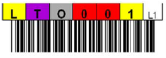
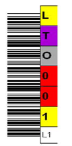
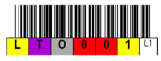
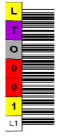
Color Palettes
The “color palette” refers to the color scheme used for the characters of the human-readable section of LTO labels. This includes the font color, and the color of the background. The same color is used for a given character, although said color may not be unique. Note that color palettes are based on personal preference, and only for human identification as they do not affect machine recognition. Three color palettes are offered: hot, warm and cool, as shown in the images below.

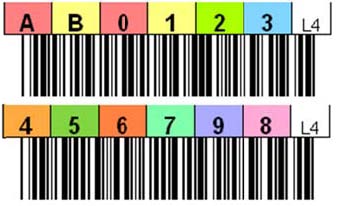
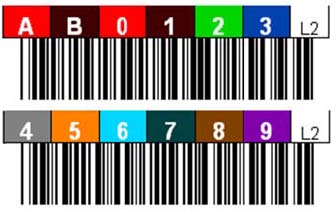
The default color palette is “Hot”, and most widely used. When desired, custom color palettes are also available for printing.
Cartridge Types
There are three types of LTO cartridges:
Data:
Used for storing useful data. All information provided up to this point in the guide refers to data cartridges. An example of a data label is shown in the below image.
Cleaning:
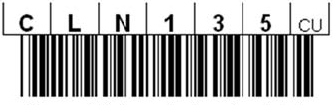
Used for cleaning the magnetic read/write heads of a tape drive. Typically, the prefix is CLNN, the media ID is CU (“Cleaning Universal”) and the color palette is black font with white background. An example of a cleaning label is shown below.
Diagnostic:
Used for tape drive testing by certain libraries. Typically, the prefix is DG with a blank space after the “G,” the media ID is as in data cartridges and the color palette is white font with black background. An example of a diagnostic label is shown below.

Label Templates
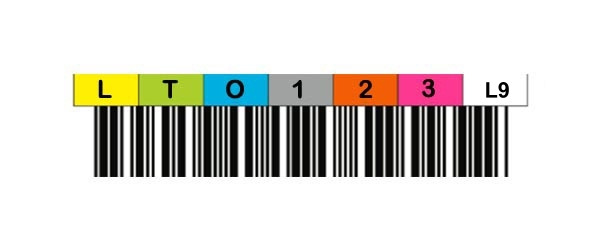
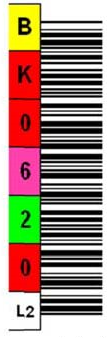
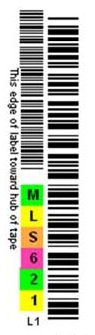
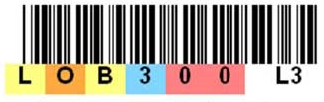
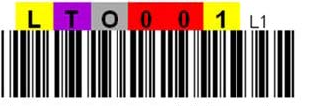
Most tape libraries are compatible with the label template shown below. Some libraries, however, require or accept other label templates. The label templates offered by SanSpot are shown in the images below, and the table below it shows which tape libraries might support each template. If your library requires a template different from the default (SS-01), please explicitly indicate this in the comment section of your label order.
TEMPLATE EXAMPLES



Summary
Available customization options, and typical configurations are summarized in the tables below.
| Parameter | Available Options | Typical/ Default Configuration | ||
| Data Label | Cleaning Label | Diagnostic Label | ||
| Human readable section length | 1-25 Characters | 6 Characters | ||
| Prefix | 0-25 Characters | 0-3 Characters | CLN | DG |
| Variable segment increment | Any | Increment by 1 | ||
| Suffix | 0-25 Characters | No Suffix | ||
| Media ID | 2 Characters | L1-L9 | CU | L1-L9 |
| Barcode Orientation | Top Bottom Left Right | Bottom | ||
| Color Palette | Hot Warm Cold | Hot | Black Font with white background | White font with black background |
| Label template | SS-01 SS-02 SS-03 SS-04 SS-19 SS-ADIC SS Type 2 SS Type 3 | SS-01 | ||
| Label Template | Compatible Tape Libraries |
| SS-01 | Most Tape Libraries |
| SS-02 | Exabyte HP Overland Data StorageTek Sun Microsystems |
| SS-03 | HP Overland Data |
| SS-04 | Qualstar |
| SS-19 | Qualstar Quantum/ATL Spectralogic |
| SS-ADIC | ADIC |
| SS-Type 2 | ADIC Spectralogic |
| SS-Type 3 | ADIC Quantum/ATL |

LTO Generations
Currently nine generations of LTO Ultrium technology have been made available and five more are planned. Between generations, there are strict compatibility rules that describe how and which drives and cartridges can be used together. Please use the table below as a reference, but always review the Manufacturer’s specifications for compatibility.
| Media ID | L1 | L2 | L3 | L4 | L5 | L6 | L7 | L8 | L9 |
| Generation | LTO-1 | LTO-2 | LTO-3 | LTO-4 | LTO-5 | LTO-6 | LTO-7 | LTO-8 | LTO-9 |
| Native Capacity | 100GB | 200GB | 400GB | 800GB | 1.5TB | 2.5TB | 6.0-9.0TB | 12TB | 18TB |
| Tape Length (meter) | 609 m | 680 m | 820 m | 846 m | 960 m | 1035 m | |||
| Tape Thickness (micrometer) | 8.9 µm | 8 µm | 6.6 µm | 6.4 µm | 6.1 or 6.4 µm | 5.6 µm | 5.2 µm | ||
| Wraps per band | 12 | 16 | 11 | 14 | 20 | 34 | 28-42 | 52 | |
| Total Tracks | 384 | 512 | 704 | 896 | 1280 | 2176 | 3584-5376 | 6656 | 8960 |
| Linear density (bits/mm) | 4880 | 7398 | 9638 | 13250 | 15142 | 15143 | 19094-19104 | 20668 | |
| End-toend passes to fill tape | 48 | 64 | 44 | 56 | 80 | 136 | 112-168 | 208 | |
| Expected tape durability, end-to-end passes | 9600 | 16000 | 16000 | 11200 | 16000 | 20000 | |||