
Nowadays, companies rely heavily on uninterrupted information flow; even minor network issues can disrupt operations, costing valuable time and resources. Effective network management is critical to ensuring your infrastructure consistently performs at its best, with reliability and minimal downtime.
Managing a network, especially with increasing fiber optic cables, can be challenging without the right tools. This is where OptoSpan's fiber patch panels at SanSpot come into play. These essential components help streamline your network, organize cables, and enable efficient management.
Let’s explore how fiber patch panels contribute to efficient network management and why they’re vital for any data center aiming for optimal performance.
What is a Fiber Patch Panel?
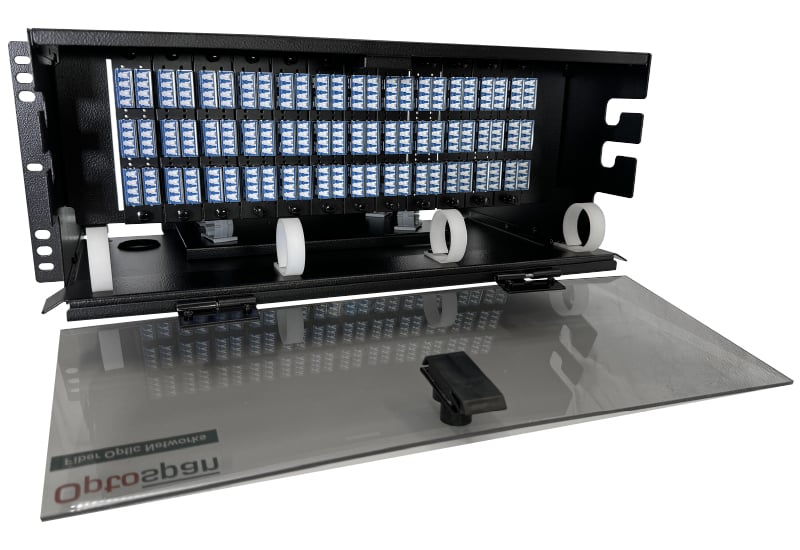
A fiber patch panel is a device designed to manage and organize fiber optic cables within a data center or server room. It acts as a central hub, neatly connecting cables and routing them to network equipment, such as switches and routers. Typically mounted on a server rack or wall, a patch panel consists of multiple ports that securely house fiber connectors, enabling easy, organized connections.
Think of a fiber patch panel as the “traffic controller” of your network. It allows you to:
- Terminate Fiber Cables: Pre-terminated cables with connectors, like LC or SC, plug directly into the panel’s ports for efficient connectivity.
- Splice Fibers: The panel has trays for splicing fibers, allowing for longer distances or custom configurations.
- Route Connections: Patch cables—short fiber cables with connectors on both ends—connect the patch panel’s ports to network devices.
With a fiber patch panel, managing your fiber network becomes much simpler. Organized and labeled cables mean no more clutter or confusion, creating an efficient and straightforward system for managing data flow.
Why Fiber Patch Panels are Essential for Efficient Network Management?
While it’s technically possible to manage a fiber network without a patch panel, OptoSpan’s fiber patch panels make network management far more efficient. Here’s why:
- Centralized Organization and Visibility: A fiber patch panel serves as a central location for all fiber connections, simplifying the network layout. Each port is clearly labeled, allowing for quick identification and troubleshooting, eliminating the need to trace cables through a tangle of wires.
- Reduced Downtime: Fast access to specific connections is essential when a network issue arises. Patch panels streamline maintenance and reconfiguration by making it easy to identify and resolve connection issues swiftly.
- Scalability: As data needs grow, adding more connections to your network becomes inevitable. Patch panels come in various port densities, allowing for easy expansion as your network scales, future-proofing your infrastructure, and avoiding costly rewiring.
- Improved Security: Many patch panels include features like locking mechanisms and dust covers, adding extra protection against accidental damage or unauthorized access.
- Enhanced Maintenance: Clean fiber connections are crucial for optimal network performance. Patch panels often include space for storing cleaning tools and splice cassettes, making it easier to maintain and protect cables.
OptoSpan’s fiber patch panels help transform network management from a complex task into a streamlined and efficient process, providing a stable, organized system for any data center.
How Do OptoSpan Patch Panels Simplify Data Center Management?
Using fiber patch panels in data centers offers several key benefits, including:
- Reduced Signal Loss: Fiber optic cables are known for lower signal loss than traditional copper wires. Patch panels help maintain this advantage by minimizing cable bending and strain, ensuring optimal signal transmission for data flow.
- Increased Airflow: Proper airflow is essential in data centers to prevent equipment from overheating. Organized cables within a patch panel reduce clutter, promoting better airflow within the rack or enclosure.
- Improved Aesthetics: A tidy, well-organized data center reflects professionalism and facilitates easier maintenance and navigation.
- Enhanced Safety: Patch panels often include color-coded labeling for different cable types, making it easier to identify specific connections and reducing the risk of accidental disconnections.
Tips for Selecting the Best Fiber Patch Panel for Your Setup
With OptoSpan’s range of fiber patch panels, selecting the one that fits your network’s requirements is crucial. Here are some factors to consider:
- Port Density: Determine how many fiber connections your network will need. OptoSpan offers panels with various port densities, from a few ports for smaller networks to high-capacity panels for larger setups.
- Mounting Options: Based on your data center’s layout, choose between rack-mountable and wall-mounted panels. Choose the option that best suits your available space and infrastructure design.
- Connector Type: Ensure the patch panel’s ports are compatible with the connectors on your fiber optic cables, such as LC or SC connectors.
- Labeling Options: Look for panels with clear labeling options, including blank or pre-printed labels, allowing you to organize and identify connections easily.
- Additional Features: Some patch panels include dust covers, locking mechanisms, or integrated splice trays. Evaluate which features best suit your security and maintenance needs.
By carefully assessing these factors, you can select a fiber patch panel from OptoSpan that will optimize your network’s performance, scalability, and manageability.
Conclusion
OptoSpan’s fiber patch panels are invaluable tools for any network environment. They streamline cable management, improve network efficiency, and provide a robust foundation for safe and reliable data transmission. Opting for high-quality patch panels from OptoSpan enhances your network’s current performance and future-proofs your infrastructure.
With the organization and efficiency of fiber patch panels, managing your network becomes a smooth, hassle-free experience. Explore how OptoSpan’s solutions at SanSpot can elevate your network management strategy today.