
Custom Fiber Optic Cable Assemblies for Flexible Network Design Needs
Every network is different, and the cabling that connects it often needs to match the space, the equipment, and the conditions around it. Standard cables work well in many cases, but some projects need a more tailored approach.
Custom fiber optic cable assemblies give network planners the freedom to choose lengths, connectors, and cable structures that fit their exact needs. This blog explains how SanSpot approaches custom designs, which options are available, and how you can plan a project that supports flexible network design.
Understanding Custom Assemblies and Harnesses
A fiber optic assembly is a cable that arrives with connectors already attached and a specific structure, so it is ready for installation. SanSpot offers custom assemblies and harnesses that are purpose-built for a particular application instead of being picked from a fixed list.
Custom fiber optic cable assemblies are planned around your own requirements, so each section of the cable can be designed with a clear purpose. This approach is helpful when standard cables do not fit the available space or the layout of the equipment. It also helps when an application has unusual performance needs.
Why Flexible Network Design Matters
Networks rarely stay the same for long, because equipment moves, racks get rearranged, and new devices are added over time. Flexibility starts at the cabling level, and custom fiber optic cable assemblies let designers decide exactly how each link should look and behave.
Here are a few ways custom cabling supports a flexible design:
- Cable lengths can be matched to real distances, which helps avoid messy extra slack in tight spaces.
- Connector styles can be chosen to suit the equipment and the environment where they will be used.
- Cable structure can be adjusted so the cable handles the surroundings it will face every day.
- Polarity and fiber mapping can be set to match the design of your application.
How the Custom Design Process Works
SanSpot engineers work closely with you at every stage of the design process. The goal is to reach the best possible solution for your unique application requirements.
The design team begins by listening to your fiber needs. Together, you define the performance requirements, the specifications, and the final deliverables. During each stage, the team collaborates with you and shares designs and expertise, including prototype drawings, so the final result is precise.
This step-by-step teamwork keeps everyone on the same page before the cable is built. It also reduces the chance of surprises later in the project.
Types of Fiber Cables That Can Be Customized
Several popular cable types can be tailored to your needs. Each one serves a different kind of network setup.
- Duplex custom fiber patch cables: These are commonly used for connecting equipment in a straightforward two-fiber arrangement.
- MPO/MTP custom fiber cables: These multi-fiber cables are useful where many connections need to fit into a small space.
- Armored custom fiber optic patch cables: These are built with extra protection for demanding surroundings.
- AOC custom fiber cables: These are active optical cables that can also be made to your specifications.
Available Customization Options
The table below lists the main options that can be customized, along with a short description of each one.
| Customization | What It Offers |
|---|---|
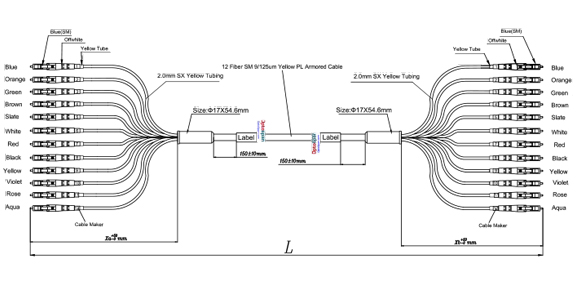
| Cable Lengths | The length of each section of the assembly can be customized. |
| Special Connectors | Options include flexible boots, compact design, waterproof, Unibody Strong, or Secure Locking. |
| Polarity and Fiber Mapping | Set to match your application design. |
| Cable Structure | Layers can be added or removed to suit your application. |
| Hybrid Cables | Single-mode and multimode fibers can be mixed in one cable. |
| Breakout Sections | A good fit for tight patch panel areas or longer equipment separations. |
| Strain Relief | A PG9 gland can be pre-installed for waterproof enclosures. |
| Custom Labeling | Labels are installed at the factory for your convenience. |
Custom Solutions for Different Environments
Different industries place different demands on their cabling. SanSpot groups its custom work into several application areas, and each one has its own typical needs.
- Data center and medical: Custom MTP/MPO cables are made for equipment interconnects, probes, and scopes.
- Military and aerospace: Mission-critical armored cables can be customized for armed forces and aerospace use. These armored cables are also highly suitable for the oil and gas industry, where safety and durability in harsh conditions are important.
- Industrial and data center: Rugged armored cables serve industrial settings, equipment manufacturers, automotive uses, and data center interconnects.
- Intra-building and inter-floor: MTP/MPO and LC breakout cables can be customized for backbone cabling between floors. They also work within a floor, linking telecommunication rooms, equipment rooms, and end-user equipment.
- Specialty and unique applications: Customizations are available where standard fiber optic cables may not be suitable.
Examples of Recent Custom Designs
Looking at real design examples can help you picture what is possible. Here are some of the designs listed by SanSpot:
- A lightweight ribbon hydra MTP/MPO cable made for a circuit board.
- A 48F MT ferrule fiber ribbon with a custom housing and custom mapping.
- A rugged MTP/MPO cable without steel armor, designed for medical use.
- A military and tactical IP68 weatherproof armored cable with PG9 glands.
- A hybrid cable that combines multimode and single-mode fibers.
- A high-density 40G MTP breakout cable going from one 24F connector to three 8F connectors.
- A secure locking LC cable that uses a key, made for high-security networks.
Turnaround Time and Reliability
Time is often a major concern when a network project is moving forward. SanSpot states that it offers one of the quickest turnarounds in the industry, with most projects going from concept to delivery within 4 to 6 weeks.
Reliability matters just as much as speed. All custom fiber optic cables from SanSpot are described as exceptionally reliable and TAA-compliant. This gives planners added confidence when the cables are part of an important network.
Tips for Planning Your Custom Cable Project
A little preparation can make a custom project run more smoothly. These simple steps can help you get started:
- Write down where the cable will be installed and what conditions it will face.
- Measure the distance for each section of the assembly as carefully as you can.
- Note the connector types needed for your equipment and patch panels.
- Decide whether you need extras such as armor, breakout sections, or waterproof strain relief.
- Share your plans with the design team so they can help define the specifications.
Having these details ready makes the early conversation with the engineers much more productive.
Conclusion
Flexible network design depends on cabling that fits the real world, not just the ideal one. Custom fiber optic cable assemblies make that possible by letting you adjust lengths, connectors, structures, and mapping for each application.
SanSpot supports this with a collaborative design process, a wide range of customization options, and a turnaround of 4 to 6 weeks for most projects. With clear planning and the right design partner, your cabling can support your network for years to come.